Exhaustion and Depletion Tell You Something
You are exhausted.
Maybe you find yourself lying in bed on Sunday night feeling like the world is closing in on you or that you will be swallowed by the black cloud that is your anxiety. You dread Monday morning, another client session, another student e-mail, another committee meeting, or another case added to your workload.
Maybe you have started counting the hours until the end of the workday, or the days until your next break. You are doing what needs to be done, but it feels like there is little left of you. You don’t recognize yourself.
You may even fantasize about quitting, changing jobs, or simply taking a break with no one needing anything from you for a while. You feel like you work 24/7, and even when you have time off, you can’t relax or fully enjoy your time. Worse, you have accumulated PTO and sick leave, but you can’t bring yourself to take it because taking time off feels more stressful than continuing to chug along with the daily grind.
You know you are feeling exhausted. Your emotional, mental, and physical energy gauge is screaming at you because you are running on empty. So you start wondering, “Am I burned out? Do I just need a break? Is this job the problem? Is this profession no longer a good fit for me?”
Exhaustion and depletion are sources of information. Don’t ignore it - your body and mind are telling you something important. You know something needs to change, but you don’t know what, where to start, or what you should do. These five steps can help.
A Five-Step Guide for Figuring Out Where You Stand & What You Need
Step 1: Identify What Exactly Is Depleting You?
It can be scary to think your exhaustion and depletion mean you're burned out. Start by getting more specific than “I may be burned out.” Exhaustion and depletion are one dimension of burnout, but they don't necessarily mean you are burned out simply because those two symptoms are present (Edú-Valsania, Laguía, Moriano, 2022). Ask yourself, “What am I actually experiencing, and when does it happen?”
Take time to notice what drains you and what doesn’t.
Is it the work itself or the amount of it? The people you serve or the system surrounding the work? Teaching or grading? Committee work, publication expectations, or administrative demands? Providing therapy or productivity requirements? Scheduling or caseload size?
Also notice where the exhaustion follows you.
Have irritability, numbness, dread, difficulty concentrating, or sleep disruption begun affecting other parts of your life?
The goal is not to diagnose yourself, but to replace a broad conclusion with a more precise piece of information about what is happening.
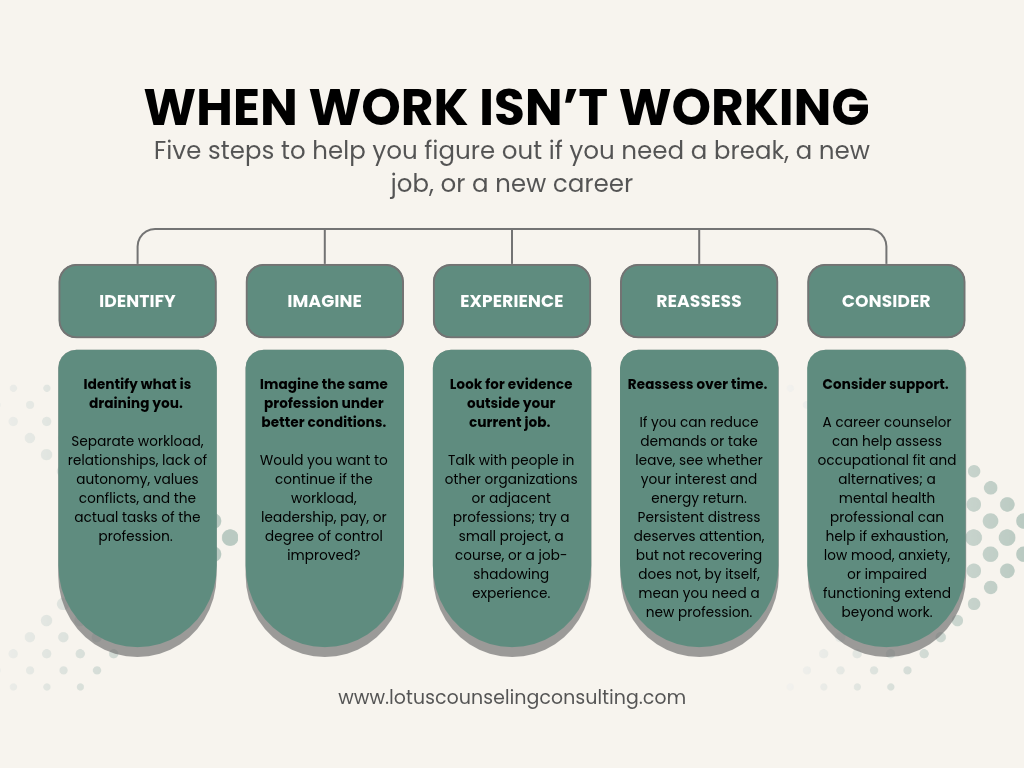
Step 2: Imagine What You Would Want If the Current Constraints Disappeared?
Imagine the same profession, or the same draining tasks, under better conditions. Would you want to continue if the workload, leadership, pay, or degree of control improved? Would you feel differently with a healthier manager, schedule, or institutional/organizational culture?
Perhaps you would still be a therapist, but see fewer clients. You might still teach, but at a different institution. Maybe you would leave administration and return to direct practice. Or perhaps, when you imagine staying in the profession under substantially better circumstances, you still feel depleted.
Imagining does not obligate you to make the change. It lets you distinguish what you want from what your circumstances currently allow and what you can actually do.
Step 3: Experience the Possibilities Before Drawing a Conclusion
You do not need to resign to learn whether something else would feel better. Where possible, look for evidence outside your current job that you might feel better in a healthier environment or in a different job within the same profession.
Take meaningful time away and notice what happens when you return. Protect a boundary you usually surrender. Talk with people in other organizations, agencies, institutions, or adjacent professions who do similar work. You may want to try a small project, take a course, or do a job-shadowing experience to see whether someone else might spark your curiosity and restore your aliveness.
These experiences give you data.
Step 4: Reassess By Looking At What You Learned
Reassess over time how you are feeling. After experimenting, return to the original question, but now ask it differently.
What improves when I rest?
What improves when the environment changes?
What does not improve even when I imagine better circumstances?
You may discover that you don’t actually want to leave your profession, but you want enough capacity to do it without sacrificing yourself to it. You may discover that you still believe in the work, but no longer want to do it for this employer. Or you may recognize that what once felt meaningful no longer aligns with your current values, priorities, and stage in life.
Step 5: Consider What Is Possible Right Now?
There is an important difference between knowing what needs to change and being able to change it. Sometimes, going through the steps above reveals the root cause of your exhaustion or even leads to a decision. Sometimes, it leads to a plan for what you need to do to improve and restore yourself. Sometimes, it simply helps you to recognize that a difficult situation (e.g., employment, relationships) is genuinely difficult, even when you cannot change it right away.
Recognizing your exhaustion and its potential cause doesn't mean you have the tools and resources to address it. Not everyone can take extended leave, reduce their workload, quit a job, or change professions. The question does not have to be, “Can I completely change my life?” It can be, “What is the next change that is actually available to me?”
Consider support to help you navigate those revelations. A career counselor can help you assess occupational fit and, if necessary, explore alternatives. A mental health provider can help if exhaustion, low mood, anxiety, or impaired functioning extends beyond work.
Why Exhaustion, Depletion, and Potential Burnout Are Particularly Complicated for Helping Professionals and Educators
For therapists, social workers, educators, healthcare professionals, faculty members, and others whose work centers on helping, teaching, mentoring, or caring for people, those questions can be particularly difficult to answer.
Your work involves significant emotional labor (Kariou et al., 2021; Lai et al., 2026; Mahoney et al., 2011). You listen, respond, regulate emotions, make decisions, solve problems, manage relationships, absorb other people’s distress, and remain present when someone else needs something from you. Those expectations extend beyond scheduled office hours or a 40-hour workweek.
You are used to sacrificing personal time and rest for your promotion, your client, your student, that next grant, or that manuscript that got a third desk reject. You work late, answer one more e-mail, finish documentation at home, accommodate another student or client, or cover for an understaffed department.
You were socialized to expect some level of personal sacrifice in your field. Yet, over the years, personal sacrifice went from a once-in-a-while thing you relied on when you really needed a couple of extra hours here or there to becoming a preferred experience and skill in your job description. You learned to ignore how work demands affect your well-being and personal life.
Even if you expected exhaustion, depletion, or burnout from your work and are in tune with your body when symptoms arise, professional knowledge can complicate things further. If you spend your days helping other people cope, you may think, “I should know how to handle this.” Your professional knowledge should help you manage your own distress; after all, that’s what you do for a living with your clients. Your ability to research, analyze, and solve complex problems will help you “think” your way through exhaustion. Your colleagues persevered, so will you.
And then there’s your identity tied to your profession (Cidlinska et al., 2023; Afrouz et al., 2025).
Acknowledging there’s an issue and considering changes, let alone leaving, may mean questioning years of education, training, credentials, relationships, sacrifices, and a professional identity you worked hard to build. You may feel shame that you worked so hard to be in this profession, and now you feel exhausted or burned out. Or you may believe that exhaustion or burnout equals weakness and incompetence in your field. Admitting you are struggling can feel like admitting you are not good at something you spent years learning and preparing for.
You Don’t Have to Figure This Out Alone
There is a particular irony in being professionally trained to help other people while struggling to know when you need support yourself (Ledingham et al., 2019). For helping professionals and educators, seeking therapy can also raise additional concerns, such as confidentiality, documentation, professional stigma (Kuosmanene et al., 2025; Smith et al., 2022), or what it means to become the person asking for help rather than providing it.
Therapy doesn't have to convince you to stay in your career or encourage you to leave it. It can help you separate exhaustion from obligation, examine the expectations and identities shaping your decisions, understand how work affects the rest of your life, and consider what you want without requiring an immediate commitment.
If circumstances mean you cannot make meaningful changes to your vocational environment, we can also focus on helping you figure out how to live within your current constraints without pretending they don't affect you, while working toward changes that may eventually become possible.
Therapy is about becoming clearer about what your exhaustion and depletion have been trying to tell you and figuring out what you want to do with that information.
Learn more about how therapy can help you by calling (252) 359-3147 or scheduling a free 15-minute consultation.
References
Afrouz, R., Robinson, K., Daddow, A., & Holmes, T. (2025). Social work graduates’ professional socialisation and identity: Perceptions and experiences of social workers and supervisors. International Social Work, 68(6), 998-1013. https://doi.org/10.1177/00208728251319494
Cidlinska, K., Nyklova, B., Machovcova, K., Mudrak, J., & Zabrodska, K. (2022). “Why I don’t want to be an academic anymore?” When academic identity contributes to academic career attrition. Higher Education, 85, 141-156. https://doi.org/10.1007/s10734-022-00826-8
Edú-Valsania, S., Laguía, A., & Moriano, J. A. (2022). Burnout: A review of theory and measurement. International Journal of Environmental Research and Public Health, 19(3), 1-27. https://doi.org/10.3390/ijerph19031780
Kariou, A., Koutsimani, P., Montgomery, A., & Lainidi, O. (2021). Emotional labor and burnout among teachers: A systematic review. International Journal of Environmental Research and Public Health, 18(23), 1-15. https://doi.org/10.3390/ijerph182312760
Kuosmanen, O., Jääskeläinen, E., Torkki, P., Seppälä, K., & Tuunainen, E. (2025). Perceived need and help-seeking for psychosocial support among health and social care professionals: A systematic review and meta-analysis. BMC Health Services Research, 25, 1-14. https://doi.org/10.1186/s12913-025-13214-6
Lai, M., Jian, M., & Wang, M. (2025). Emotional labor of social workers and associated factors resulting in positive/negative outcomes: A systematic review. The British Journal of Social Work, 56(4), 1462-1484. https://doi.org/10.1093/bjsw/bcaf228
Ledingham, M. D., Standen, P., Skinner, C., & Busch, R. (2019). “I should have known”. The perceptual barriers faced by mental health practitioners in recognizing and responding to their own burnout symptoms. Asia Pacific Journal of Counselling and Psychotherapy, 10(2), 125-145. https://doi.org/10.1080/21507686.2019.1634600
Mahoney, K. T., Buboltz, W. C., Buckner Jr., V. J. E., & Doverspike, D. (2011). Emotional labor in American professors. Journal of Occupational Health Psychology, 16(4), 406-423. https://psycnet.apa.org/doi/10.1037/a0025099
Smith, J. M., Smith, J., McLuckie, A., Szeto, A. C. H., Choate, P., Birks, L. K., Burns, V. F., & Bright, K. S. (2022). Exploring mental health and well-being among university faculty members: A qualitative study. Journal of Psychosocial Nursing and Mental Health Services, 60(11), 17-25. https://doi.org/10.3928/02793695-20220523-01